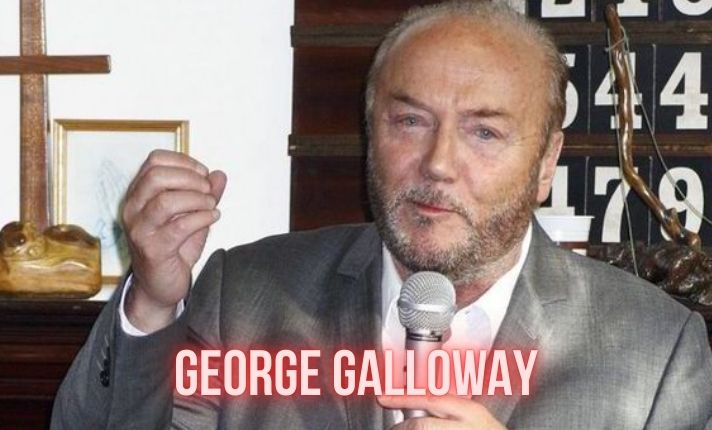
George Galloway remains one of the most recognisable and polarising figures in modern British politics. His career spans five decades, touching activism, media broadcasting, international controversies, multiple parliamentary victories, and dramatic comebacks. As of 2025, Galloway continues to influence public debate through political campaigns, social media broadcasting, and leadership within the Workers Party of Britain. His path from a working-class childhood in Dundee to a headline-making national figure shows the unique blend of activism, conviction, and controversy that has defined his name for years.
- Quick Facts
- Early Life Activism, War on Want, and First Parliamentary Term
- Career & Rise to Fame
- Break with Labour — Iraq War, Mariam Appeal & Expulsion
- Later Parliamentary Career
- What is George Galloway’s Net Worth?
- Political Views and Controversies
- 2024–2025: Return
- Personal Life & Relationships
- Conclusion
- FAQs
Quick Facts
| Full Name | George Galloway |
|---|---|
| Age | 71 years old (as of 2025) |
| Date of Birth | 16 August 1954 |
| Parents | George Galloway Sr. and Sheila O’Reilly |
| Religion | Atheist |
| Net Worth | 1 to 5 million dollars (2024–2025 estimates) |
| Height | 5 ft 9 in (175 cm) |
| Spouse/Partner | Putri Gayatri Pertiwi |
| Ethnicity | Scottish with Irish ancestry |
| Nationality | British |
| Source of Wealth | Politics, broadcasting, authorship, media work |
| Education | Harris Academy, Dundee |
Early Life Activism, War on Want, and First Parliamentary Term
George Galloway was born in Dundee, Scotland, in 1954. He grew up in the Lochee area, often referred to as the Irish quarter. His family lived in modest conditions, and he has described his birthplace as an attic in a tenement known locally as Tipperary. His working-class background shaped his worldview. His father worked as an electrician, electromechanical engineer, and later as a teacher. His mother, Sheila O’Reilly, was a Scot of Irish descent who worked in factories and cleaning roles.
A formative moment in Galloway’s early life occurred at age 13. He joined the Labour Party Young Socialists, reportedly lying about his age to join early. The experience exposed him to political organising and moral arguments around inequality. George Galloway quickly became active within the Dundee Labour movement, eventually serving as secretary of the Dundee Labour Party while still in his teens. That early political exposure became his turning point. It set him on a path far outside traditional working-class expectations. Instead of entering a trade, he leaned fully into activism.
He attended Charleston Primary School and Harris Academy. He played football enthusiastically during his youth, representing West End United and Lochee Boys Club. His football background gave him confidence and presence. In 1973, at age 19, he joined the Transport and General Workers’ Union, which later merged into UNITE. Union activism became his first major platform.
His national profile grew after joining War on Want in 1983. At age 29, he became its general secretary. The role placed him in humanitarian campaigns across Africa and the Middle East. George Galloway wrote about famine in Eritrea and travelled widely as part of anti-poverty missions. The exposure helped build his reputation as a principled activist focused on international justice.
In 1987 he stepped into parliamentary politics. Running as a Labour candidate, he defeated Roy Jenkins, leader of the Social Democratic Party, to win the Glasgow Hillhead constituency. At 32 years old, he became one of Labour’s rising figures. His victory over a high-profile opponent cemented his reputation as a powerful campaigner capable of overturning established political expectations.
Career & Rise to Fame
George Galloway’s rise to national fame came through a mix of powerful rhetoric, controversial foreign policy positions, and a reputation for being an uncompromising political figure. From the late 1980s to the early 2000s, he became one of Labour’s most outspoken voices on international politics, especially the Middle East.
During his early parliamentary years, he focused on issues of global justice. He positioned himself as a critic of Western interventionism. His outspoken views attracted admiration from supporters and scepticism from opponents. His speeches drew national attention for their conviction and theatrical delivery. His oratorical reputation eventually defined how he would be viewed throughout his career.
He served as MP for Glasgow Hillhead until boundary changes created Glasgow Kelvin. George Galloway held that seat with strong majorities in both the 1997 and 2001 general elections. By the early 2000s, Galloway had become one of Labour’s most identifiable figures on anti-war politics. His criticism of the Gulf War and later the Iraq sanctions made him a frequent presence in media debates.
His activism included founding the Mariam Appeal in 1998. The organisation was created to campaign against sanctions on Iraq. Its mission centred on supplying medical support to Iraqi children affected by sanctions. Galloway frequently travelled to Iraq and the Middle East during this period. His work brought him international visibility and increasing controversy. Supporters viewed his efforts as humanitarian advocacy. Critics questioned the political implications of his foreign relations.
By the early 2000s, his anti-war stance became the central feature of his political identity. This culminated in his opposition to the Iraq War, which accelerated tensions between him and the Labour leadership. The stage was set for one of the most dramatic political splits of his career.
Break with Labour — Iraq War, Mariam Appeal & Expulsion
The early 2000s marked George Galloway’s most contentious period inside the Labour Party. As the United States and the United Kingdom prepared to invade Iraq in 2003, Galloway became one of the loudest and most consistent critics within Labour.
He was accused of urging British soldiers to refuse what he described as illegal orders. Labour’s disciplinary panel later argued that his public comments brought the party into disrepute. Galloway maintained that his criticisms were directed at political leadership, not military personnel. The disagreement escalated. In 2003, Labour expelled him from the party.
The expulsion was a political watershed. It broke his long association with Labour, which he had joined as a teenager. After the split, he positioned himself as a leading anti-war independent voice. The Mariam Appeal continued to be referenced during this period. Some critics alleged questions around its funding structure. Galloway denied wrongdoing, and no criminal charges were brought.
The Iraq War controversy placed him at the centre of global media attention. His combative debating style became widely recognised. His Senate testimony in the United States in 2005, confronting allegations linked to the UN Oil-for-Food scandal, drew international headlines. His refusal to soften his rhetoric established him as one of the most distinctive political personalities in Britain.
Later Parliamentary Career
Following his expulsion from Labour, Galloway aligned with the newly formed Respect Party. In the 2005 general election, he stood for the seat of Bethnal Green and Bow in London. In a major upset, he defeated Labour MP Oona King by 823 votes. His victory reflected strong support from anti-war voters and local communities.
He served as MP for Bethnal Green and Bow from 2005 to 2010. During this period, he also expanded his media presence. George Galloway became a broadcaster on TalkSport and hosted The Mother of All Talk Shows. His style resonated with audiences seeking commentary outside mainstream ideological boundaries.
In 2012, he returned to Parliament by winning the Bradford West by-election. The result shocked political observers. He overturned a Labour majority of more than 5,000 votes. His campaign was supported by younger voters and segments of the Bradford Muslim community. The victory reinforced his reputation as a politician capable of unseating large political machines.
In 2019 he founded the Workers Party of Britain. The party positioned itself as a socially conservative and economically left platform. It appealed to voters disaffected by Labour’s direction under Jeremy Corbyn and later leadership changes.
His political comeback continued in February 2024. He won the Rochdale by-election after Labour withdrew support from their own candidate. His campaign centred heavily on the Gaza conflict. George Galloway declared after winning that the result was dedicated to Gaza. However, his return to Parliament was short. In the July 2024 general election, he lost the seat to Labour candidate Paul Waugh.
In 2025 he announced his return to Scottish politics. He declared plans to run for the Scottish Parliament in 2026 for Glasgow Southside and on the Glasgow regional list.
What is George Galloway’s Net Worth?
Net worth estimates for George Galloway vary widely because a public and verified financial declaration does not exist. Most estimates rely on media reports or speculative modelling.
According to NetWorthSpot, his estimated net worth is about 846,200 dollars. Other outlets estimate figures from 1 to 5 million dollars, citing income streams from:
• parliamentary salary during years in office
• broadcasting and media hosting
• book publication
• paid speaking engagements
• political leadership roles
• online broadcasting platforms
As of 2025, no major financial institution such as Forbes has published an official valuation. His revenue sources are diverse. His media projects, including independent broadcasting of The Mother of All Talk Shows, contribute to ongoing income. His political work, though not as financially substantial, adds public visibility.
Political Views and Controversies
George Galloway has been associated with several controversies. His political views span a wide spectrum and have shifted over time. His positions frequently attract strong reactions. Below are major themes that have defined his public image.
Allegations and Criticism
He was accused of making comments that critics viewed as sympathetic to controversial leaders in the Middle East. George Galloway denied such interpretations and insisted that he opposed Western interventionism. Some political groups alleged that his statements on certain conflicts crossed rhetorical boundaries. His testimony in the United States Senate in 2005 was a defining moment. Supporters praised his defence. Opponents framed it as combative.
He was alleged by political opponents to promote divisive rhetoric during local campaigns. Critics argued that his direct style influenced the tone of by-election battles. Galloway consistently rejected accusations of sectarian politics.
He became associated with controversy on social issues. In 2024 he stated that as a father of six children he held socially conservative views on family structure. Some left-leaning groups criticised these comments. They accused him of adopting positions contrary to modern equality standards. Galloway stated that the claims misrepresented his stance.
Several commentators alleged that his comments on transgender rights contributed to heated debate. George Galloway rejected the allegations. Public reactions to these comments varied among political constituencies.
In 2025 he reversed his historic opposition to Scottish independence. Some political analysts argued that the shift was strategic. Others viewed it as a genuine evolution. His public statement framed it as a response to changing national conditions.
2024–2025: Return
George Galloway re-entered Parliament in February 2024 after winning the Rochdale by-election. His victory occurred in a unique political climate. Labour’s candidate had been withdrawn. The Gaza conflict influenced political narratives, and Galloway ran a campaign rooted in foreign policy.
After taking office, he continued to broadcast regularly. His parliamentary tenure lasted approximately 92 days. In the July 2024 general election he lost his seat. The result returned Rochdale to Labour.
In August 2025 he shifted focus to Scotland. George Galloway announced his candidacy for the 2026 Scottish Parliament elections. His decision marked a significant repositioning. It showed his willingness to re-engage with Scottish politics after years focused on Westminster campaigns.
Throughout 2025 he continued to lead the Workers Party of Britain. He maintained an active presence online. His political commentary reached millions across social platforms. His position within the party gave him influence, even without a parliamentary seat.
Personal Life & Relationships
George Galloway’s personal life has been prominent in media coverage. He has been married multiple times. His current spouse is Putri Gayatri Pertiwi. George Galloway has several children. Details about his family are occasionally referenced in his public speeches but he does not release extensive personal information.
His previous marriages included relationships with Rima Husseini and other partners. Public records show that his family life has intersected with his political narrative. In 2024 he referenced being a father of six children. Media outlets frequently cite this when discussing his social views.
He is known for enjoying football, boxing, reading and film production. He has produced documentaries and has engaged in charity projects. His media career expanded after parliamentary roles. He appeared on Celebrity Big Brother in 2006. That appearance became widely discussed due to a moment in which he acted as a cat during a televised task. It remains one of the most referenced moments of his public life.
Despite controversies, he maintains a consistent support base. His followers respond to his direct style and rhetorical skill. His detractors point to his comments and foreign policy positions as problematic. His personal life, though often referenced by media, is rarely discussed at length by Galloway himself.
Conclusion
George Galloway’s life combines activism, political conviction, controversy, and repeated reinvention. From a working-class upbringing in Dundee to multiple parliamentary terms and headline-creating campaigns, he has shaped political debate for decades. His voice has been central to discussions on foreign policy, anti-war activism, workers’ issues, media broadcasting and now Scottish political identity.
As of 2025, he continues to influence public dialogue through the Workers Party of Britain and through his online broadcasting platforms. His decision to re-enter Scottish politics marks another potential chapter in a career defined by unexpected turns. Whether admired or criticised, his presence remains unmistakable. He continues to be a figure who provokes debate, challenges political norms, and shapes public conversation both inside and outside Parliament.
FAQs
What is George Galloway’s age?
71 years old in 2025.
What is George Galloway’s net worth?
Estimates range from 846,000 to 5 million dollars.
What political party does he lead?
The Workers Party of Britain.
Which seat did he win in 2024?
Yes, to Putri Gayatri Pertiwi.