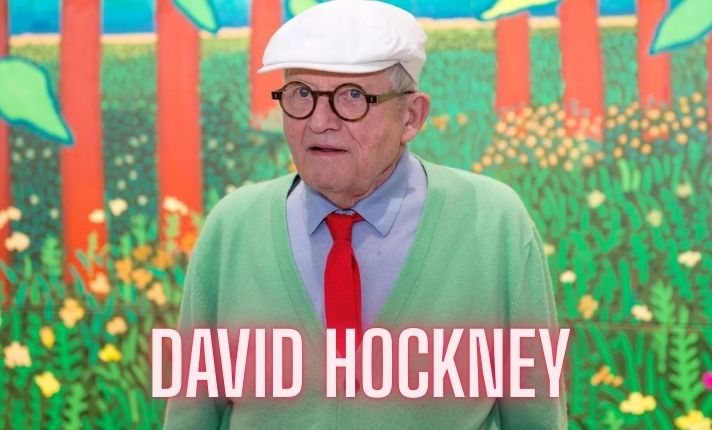
David Hockney is a British painter, draftsman, printmaker, photographer, stage designer, and theorist widely regarded as one of the most influential artists of the 20th and 21st centuries. A central figure in the Pop Art movement and later a pioneer of digital art, Hockney reshaped how modern audiences understand space, colour, perception, and visual storytelling. By 2025, he stands not only as a prolific creator but as a living institution in global art history.
- Quick Facts
- Early Life & Origin Story
- Art Education and Intellectual Formation
- Early Career and the Rise of British Pop Art
- Move to California and Artistic Transformation
- Artistic Innovation and Theories of Seeing
- Stage Design and Cross-Disciplinary Work
- Later Career and Digital Art
- What Is David Hockney’s Net Worth?
- Personal Life & Relationships
- Controversies
- Legacy
- Conclusion
- FAQs
Quick Facts
| Detail | Information |
|---|---|
| Full Name | David Hockney |
| Age (2025) | 87 |
| Date of Birth | 9 July 1937 |
| Place of Birth | Bradford, West Yorkshire, England |
| Parents | Kenneth and Laura Hockney |
| Height | Approx. 5 ft 9 in (1.75 m) |
| Spouse/Partner | Not married |
| Children | None |
| Ethnicity | White British |
| Nationality | British |
| Profession | Artist, painter, draftsman |
| Source of Wealth | Fine art sales, exhibitions, royalties |
| Education | Royal College of Art |
| Net Worth (2025) | Estimated £100 million to £150 million |
Early Life & Origin Story
David Hockney was born on 9 July 1937 in Bradford, an industrial city in West Yorkshire. He grew up in a working-class household shaped by post-war austerity, civic duty, and intellectual curiosity. His father, Kenneth Hockney, was a conscientious objector during World War II and a strong believer in independent thought.
From an early age, Hockney demonstrated exceptional visual sensitivity. He drew constantly, not as recreation but as observation. Factories, streets, interiors, and faces became visual problems to be solved.
Unlike many artists who emerge from bohemian environments, Hockney’s creativity developed within discipline and constraint. This tension between freedom and structure would later define his artistic philosophy.
The turning point of his youth came during formal art education. Teachers quickly recognised that Hockney was not merely skilled but conceptually driven. He was interested in how images work, not just how they look.
Art Education and Intellectual Formation
Bradford College of Art
Hockney studied at the Bradford College of Art, where he absorbed traditional techniques while questioning academic conventions. He was less interested in realism than in representation.
He challenged tutors by refusing to follow stylistic orthodoxy, insisting on personal symbolism and experimentation. This resistance was not rebellion but conviction.
Royal College of Art
Hockney later attended the Royal College of Art, where he encountered a generation of artists who would define British modernism. He graduated despite initial resistance from the institution, which questioned his unconventional approach.
At the RCA, Hockney began exploring sexuality, identity, and narrative through coded imagery. At a time when homosexuality was still criminalised in Britain, his work carried quiet defiance.
This period marked the emergence of Hockney not just as an artist but as a thinker.
Early Career and the Rise of British Pop Art
London and the 1960s Art Scene
In the early 1960s, Hockney became associated with British Pop Art, though his work never fully aligned with its commercial irony. While contemporaries focused on mass media imagery, Hockney pursued personal experience.
His early paintings explored love, desire, and daily life with symbolic abstraction. Text, geometry, and figurative elements coexisted within the same canvas.
Critics quickly identified him as a distinctive voice rather than a follower of trends.
Sexual Identity in Art
Hockney was among the first British artists to openly reference same-sex relationships in his work. Rather than overt activism, his approach normalised intimacy through depiction.
These works challenged cultural norms quietly but persistently, contributing to broader social change through representation.
Move to California and Artistic Transformation
Relocation and Cultural Shift
In the mid-1960s, Hockney moved to Los Angeles. The relocation proved transformative. California’s light, architecture, and openness reshaped his palette and subject matter.
He was fascinated by swimming pools, modern homes, and spatial clarity. These elements became central motifs in his work.
The contrast between British greys and Californian brightness marked a radical shift in his visual language.
The Swimming Pool Paintings
Hockney’s pool paintings are among the most recognisable works of modern art. They explored transparency, reflection, and movement through deceptively simple forms.
Water became both subject and conceptual challenge. How does one paint something constantly in motion.
These works cemented Hockney’s international reputation and commercial success.
Artistic Innovation and Theories of Seeing
Photography and Multiple Perspectives
Hockney rejected single-point perspective as artificial. He believed it misrepresented how humans actually see the world.
He experimented with photographic collages composed of multiple images taken from different angles and moments. These works challenged conventional notions of time and space.
His approach anticipated later digital techniques by decades.
Theories on Optics
Hockney proposed controversial theories suggesting that Old Masters used optical devices to achieve realism. These ideas sparked debate but reinforced his reputation as an intellectual provocateur.
Whether accepted or disputed, his theories reopened scholarly conversations about art history.
Stage Design and Cross-Disciplinary Work
Beyond painting, Hockney designed sets for opera and theatre. His stage work demonstrated mastery of colour, scale, and spatial illusion.
Unlike decorative set designers, Hockney treated the stage as a total artwork. Every element contributed to narrative atmosphere.
This cross-disciplinary success reinforced his belief that art is not medium-specific.
Later Career and Digital Art
Embracing Technology
In later life, Hockney embraced digital tools with enthusiasm. He created works using tablets and digital drawing applications.
Rather than viewing technology as a threat, he saw it as an extension of traditional drawing.
His digital works were exhibited alongside oil paintings, challenging hierarchies of medium.
Return to Yorkshire Landscapes
Hockney returned to the landscapes of his youth, painting the Yorkshire countryside with renewed intensity.
These works combined digital sketches with large-scale paintings, blending innovation with nostalgia.
They reaffirmed his lifelong fascination with perception and place.
What Is David Hockney’s Net Worth?
As of 2025, David Hockney’s net worth is estimated between £100 million and £150 million.
Primary Income Sources
- Fine art sales at auction and private sale
- Museum retrospectives and licensing
- Print editions and royalties
- Intellectual property and publication rights
Several of his works have achieved record-breaking prices, placing him among the wealthiest living artists.
Personal Life & Relationships
David Hockney has never married and has no children.
He has maintained long-term personal relationships while valuing independence. Privacy and autonomy are central to his lifestyle.
Hockney lives between England and Europe, continuing to work daily well into his late eighties.
Controversies
Hockney’s controversies have been intellectual rather than personal.
His theories on optics sparked academic dispute. His refusal to follow institutional expectations occasionally created friction.
He has also spoken critically about smoking bans and modern cultural norms, generating debate.
None of these controversies have diminished his artistic standing.
Legacy
David Hockney’s legacy is monumental.
He expanded what painting could be in an age dominated by photography and digital media. He proved that innovation and tradition are not opposites.
His influence spans generations, mediums, and disciplines. Museums, scholars, and artists continue to engage with his ideas.
He is widely regarded as one of the greatest British artists of all time.
Conclusion
David Hockney’s career reflects fearless curiosity and relentless experimentation. From Bradford to California, from canvas to tablet, he has never stopped questioning how we see.
By 2025, his work remains vibrant, relevant, and intellectually challenging. Few artists achieve such longevity without stagnation.
Hockney’s art does not merely depict the world. It teaches us how to look at it.
FAQs
Who is David Hockney?
He is a British artist and painter.
How old is David Hockney in 2025?
He is 87 years old.
What is David Hockney best known for?
Swimming pool paintings and modern landscape art.
What is David Hockney’s net worth?
His net worth is estimated between £100 million and £150 million.
Is David Hockney still working?
Yes, he continues to create art actively.