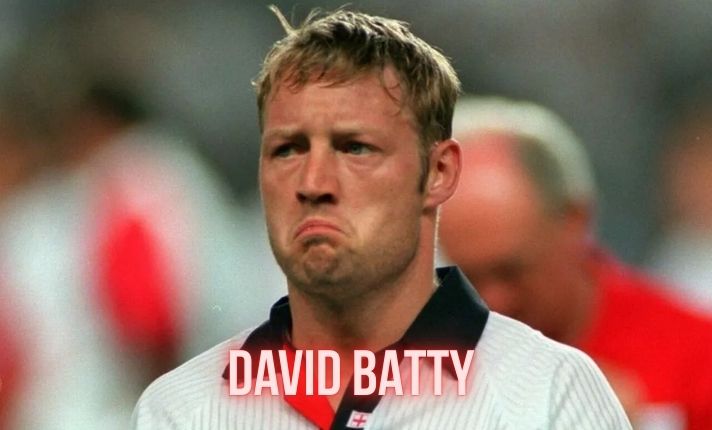
David Batty remains one of English football’s most recognisable midfielders despite living far from the spotlight since retiring in 2004. His career stretched across the most defining periods of the English game, from the final years of the First Division to the rise of the Premier League. He built a reputation as a relentless defensive midfielder who prioritised work rate, discipline, and team structure over individual flair. As of 2025, his legacy continues to attract high-intent research queries due to his unique personality, private lifestyle, and lasting football impact.
Quick Facts
| Category | Details |
|---|---|
| Full Name | David Batty |
| Age | 56 (as of 2025) |
| Date of Birth | 2 December 1968 |
| Parents | Not publicly disclosed |
| Net Worth | 5 million to 13 million USD (estimates vary) |
| Height | 1.73 m |
| Spouse/Partner | Married, name not publicly disclosed |
| Ethnicity | White British |
| Nationality | English |
| Source of Wealth | Football salary, endorsements, investments |
| Education | Schooling in Leeds, youth football academy training |
Early Life of David Batty
David Batty was born in Leeds in 1968, and his childhood environment shaped the determination he later displayed on the pitch. His early years mirrored the working-class culture of Yorkshire, where physical toughness and personal discipline were everyday values.
The turning point in Batty’s youth came when he joined the Leeds United youth system. Football was not initially his ambition, but his talent forced him into the professional pathway. Coaches quickly identified his ability to win the ball, maintain composure, and follow tactical instructions. These traits formed the core of his identity as a footballer.
He debuted for Leeds at 18, long before media training or player branding became common in the sport. This early start developed his thick skin and his refusal to get carried away by fame. Batty often described football as something he was good at rather than something he lived for, which later explained his decision to retire quietly and avoid publicity.
Career
David Batty built his career through consistency, reliability, and a rare tactical discipline. His progression happened through some of the most historically important English clubs, and he contributed to major achievements that defined the Premier League era.
Club Career: Leeds → Blackburn → Newcastle → Return to Leeds
Leeds United (1987 to 1993)
Batty’s senior debut under Billy Bremner came in November 1987 against Swindon Town. Leeds were a club in transition, but Batty quickly positioned himself as an essential part of the rebuilding process.
Key contributions at Leeds included:
- Helping the club secure promotion from the Second Division in the 1989 to 1990 season.
- Becoming a starting midfielder during Leeds United’s First Division title win in 1991 to 1992.
- Establishing a reputation similar to that of Bremner, whose aggressive midfield style influenced Batty’s development.
A notable anecdote from this era involved Batty strengthening his body using a morning drink of raw egg mixed with sherry, a method encouraged by Bremner. It symbolised old-school training culture, and Batty embraced it with the same discipline he applied to his performances.
Blackburn Rovers (1993 to 1996)
In October 1993, Batty transferred to Blackburn Rovers, a club rapidly climbing under Kenny Dalglish. The move helped finance Leeds’s squad changes and gave Batty the opportunity to compete for top honours.
Achievements at Blackburn included:
- Contributing to the club’s 1994 to 1995 Premier League title campaign.
- Maintaining a central midfield role despite intense competition for places.
Batty famously refused to accept his Premier League winner’s medal. He believed he had not contributed enough matches due to injuries and therefore felt unworthy of the award. This decision strengthened his public image as a grounded, self-critical professional.
Newcastle United (1996 to 1998)
Batty moved to Newcastle United for 3.75 million pounds. Under Kevin Keegan, Newcastle were one of England’s most exciting attacking teams, nicknamed “The Entertainers.”
Key highlights included:
- Two successive Premier League runners-up finishes.
- A memorable goal in 1996 to 1997, where Batty scored a long-range lob against Wimbledon.
- Participation in Newcastle’s cup runs, including the 1998 FA Cup Final.
His intensity sometimes sparked conflict. During a Champions League match, Batty and Graeme Le Saux clashed physically after a misunderstanding, a moment still recalled in discussions about competitiveness and dressing-room dynamics.
Return to Leeds United (1998 to 2004)
Batty returned to Leeds for 4.4 million pounds in December 1998. He became a veteran leader in a team filled with future stars. Even as injuries accumulated, his deep tactical understanding supported a squad competing in the Champions League and the Premier League’s top tier.
His final years at Leeds were marked by:
- A rib injury shortly after returning
- A serious Achilles tendon issue
- The club’s financial crisis and eventual relegation battle
Batty played his last professional match in early 2004 and retired months later, choosing not to pursue media opportunities or coaching roles.
International Career (England)
David Batty earned 42 caps for the England national team between 1991 and 1999. He made his debut under Graham Taylor, becoming Leeds United’s first England international in nearly a decade.
International highlights included:
- Representing England at Euro 1992.
- Appearing in every match at the 1998 FIFA World Cup under Glenn Hoddle.
- Playing in the historic 0 to 0 draw against Italy in Rome, securing England’s qualification for France 98.
- Taking the decisive penalty in the shootout against Argentina, which was saved, sending England out of the tournament.
Despite the missed penalty, Batty maintained universal respect for his composure and team-first attitude.
Playing Style & Reputation
David Batty was known for his defensive intelligence. He understood space, timing, and risk management better than most midfielders of his era.
Defining traits included:
- Relentless tackling
- Quick transitions after winning the ball
- Minimal mistakes in possession
- Tactical discipline
- Physical durability in high-pressure matches
Managers like Kevin Keegan described him as one of the most important midfielders in defensive systems because he allowed attacking players to express themselves freely. Batty rarely lost composure and maintained consistent performance standards regardless of opponent or competition.
His reputation centered on hard work, not showmanship. Fans and teammates respected his humility, reliability, and refusal to chase individual glory.
Post-Retirement Life & Recent Developments
David Batty’s post-football life stands out for its privacy. Unlike many contemporaries who pursued punditry or coaching, Batty withdrew from public life almost entirely.
Confirmed information about his post-retirement years includes:
- Living a private life in Yorkshire
- Rarely giving interviews or public statements
- Briefly appearing in local charity events without media attention
- Interest in community initiatives related to Leeds United heritage
- Supporting the 2025 WILKO92 campaign honouring former Leeds manager Howard Wilkinson
Rumours exist of possible work abroad in fitness or sports administration, but these have not been verified by credible mainstream outlets.
His decision to reject media exposure increased public curiosity, making him a subject of frequent high-intent searches about “where is David Batty now.”
What is David Batty’s Net Worth?
According to CelebrityNetWorth and several 2024 to 2025 online sources, David Batty’s net worth is estimated between 5 million and 13 million USD. No Forbes data is available for him, and financial details remain partially speculative because Batty does not maintain public business profiles.
Estimated breakdown based on available data:
- Career salary earnings across Leeds, Blackburn, and Newcastle
- England appearance bonuses
- Match bonuses from title-winning campaigns
- Properly managed savings and pension schemes
- Private investments and property income
There is no confirmed evidence of ownership in major businesses, coaching roles, or media contracts.
Personal Life & Relationships
Batty has always kept his family life private. He is married, but his spouse’s name is not publicly disclosed. He prefers to avoid attention and historically declined interviews that discuss his personal relationships.
Known facts:
- Married with children, but identities are not public
- Has consistently rejected media requests about family life
- Prioritises privacy over public recognition
- Maintains a low online presence
His preference for anonymity adds to the mystery often mentioned by supporters and former teammates.
Controversies
David Batty’s career involved moments of conflict, but none escalated into formal disciplinary scandals. His controversies were usually competitive incidents on the pitch.
Notable examples:
- He was involved in an altercation with Graeme Le Saux during a Champions League match. This was reported as a misunderstanding triggered by a miscommunication.
- Reports stated Batty had an incident with Nicky Butt, where he lifted the Manchester United midfielder by the throat during a heated exchange.
- Some media outlets alleged that Batty’s relationship with certain managers was strained due to his refusal to engage in celebrity culture.
None of these incidents resulted in long-term damage to his reputation. The controversies reflect competitive intensity rather than off-field misconduct.
Legacy and Why David Batty Matters Even After 20 Years
David Batty’s legacy extends far beyond statistics. He represents a generation of English footballers who valued discipline over headlines. Supporters continue to celebrate him for his authenticity in an era that increasingly rewards branding.
Reasons his legacy remains strong:
- He was integral to two major English title-winning teams: Leeds United in 1992 and Blackburn Rovers in 1995.
- His defensive midfield role shaped modern interpretations of the position.
- He remains a cult figure for Leeds supporters.
- His work ethic and simplicity contrast sharply with the modern football celebrity model.
- His decision to leave the public eye makes his career feel timeless rather than commercialised.
Even after two decades, David Batty continues to be remembered for reliability, humility, and fierce competitiveness.
Conclusion
David Batty’s career stands as a rare example of a footballer defined by substance over spectacle. He contributed to iconic moments in English football history and maintained a fully grounded personality throughout his career. His decision to step away from the spotlight only strengthened his legacy as someone who viewed football as a profession rather than a platform for fame.
In 2025, Batty’s name continues to attract high-intent interest due to his guarded privacy, respected career achievements, and the long-lasting impact he left on fans and teams across the country.
FAQs
What teams did David Batty play for?
Leeds United, Blackburn Rovers, Newcastle United.
How many England caps did he earn?
He earned 42 caps.
Did David Batty win the Premier League?
Yes, with Blackburn Rovers.
Why did he refuse his Premier League medal?
He felt he had not contributed enough matches.
Where is David Batty now?
He lives privately in Yorkshire.
Was David Batty a defensive midfielder?
Yes, he specialised in ball-winning and defensive structure.