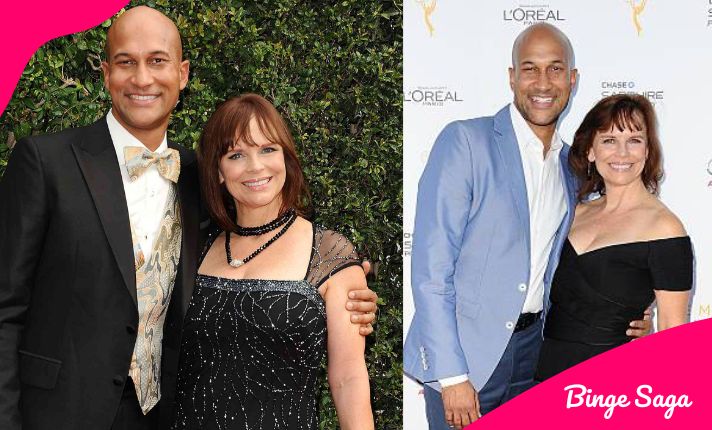
There are people whose work quietly changes what an audience believes. Cynthia Blaise is one of them. Audiences may not always know her name, but they have heard her work — the accents, the speech patterns, the small inflections that make a character feel real. She has acted, taught, and coached on sets for decades. She was also, for nearly twenty years, married to the comedian and actor Keegan-Michael Key. Their relationship and eventual split made headlines, but that headline story has always been only one part of Cynthia Blaise’s life.
- Cynthia Blaise Career
- The Dialect Coach
- Teaching and Workshops
- Marriage to Keegan-Michael
- The Settlement Public Documents and Private Impact
- Press Cycle and The Choices
- Projects List Her Name
- Retreating From Cameras and Public Events
- Cynthia Blaise Net Worth
- Why Dialect Coaches Matter
- Cost Of Public Transitions
- What Remains of a Career Defined by Craft
- Final Note
This is a long look at her: the parts of a career that took place in rehearsal rooms and recording booths, the moments that led to a public divorce, and the quieter years that followed. I tried to keep this readable for anyone who comes for the celebrity angle but stays for the background on an under-noticed working artist.
Cynthia Blaise Career
Cynthia Blaise came to performance in a classical way — by studying it. She trained for the stage and pursued academic credentials that would give her tools beyond improvisation and instinct. Early in her career she landed small but meaningful parts, and one of her first wider notices came with a role in Star Trek V: The Final Frontier (1989), where she played a younger Amanda Grayson, Spock’s mother. Small roles like that can be doorways: they put a performer in front of casting directors, directors, and other actors who might later need what she had to offer. Her screen résumé eventually included episodic television and character work on film projects across several decades.
A player with both stage instincts and trained technique often becomes useful in other ways on a production. Blaise’s background made it natural for her to teach, to help other actors find a voice for a role, and to prepare performers for dialect work. That path — from actor to specialist — is common in theatre communities where actors often teach between gigs. For Blaise, those secondary roles evolved into a primary calling for a number of notable films and TV shows.
The Dialect Coach
If you’ve ever been struck by an actor’s believable regional accent in a movie, a dialect coach likely had a hand in creating it. Cynthia Blaise worked as a dialect coach on multiple productions, and her credits show she was trusted to shape the way characters sounded.
One of the credits that often circulates is the 2002 film 8 Mile. Blaise is listed among the dialect coaching credits for that film, a project where getting the local Detroit cadence right mattered to the story and audience reception. For actors, a coach isn’t only about imitation; it’s also about creating a vocal life that sits inside a character’s emotional truth. Blaise’s work on 8 Mile put her in a category of practitioners who help actors make the spoken details feel lived-in.
Other entries on her credits list include work on features and TV that span different registers: comedies, dramas, and even voice projects. The range of productions on which she worked — from mainstream studio films to television series — suggests that directors and casting teams saw her as reliable and precise. That reputation matters in an industry where many specialists operate quietly and repeatedly for years.
Teaching and Workshops
Alongside on-set coaching, Blaise also taught. She worked with students at universities and offered workshops in voice and speech. The move between academic settings and production floors is natural for many coaches: schools provide a place to teach fundamentals, and sets test those fundamentals under pressure.
Institutions she is connected to in various bios and alumni notes include a number of U.S. universities where voice and dialect are part of acting curricula. That kind of institutional teaching requires patience, the ability to parse sound into teachable pieces, and the capacity to translate technical work into something an actor can use under lights. Students who later go into professional work often carry those early lessons with them, and coaches like Blaise end up influencing performances long after they have left a particular classroom.
Marriage to Keegan-Michael
Cynthia Blaise and Keegan-Michael Key met through theatre. They were both engaged with stage work in Detroit, and their paths crossed in a production. They married in 1998 and stayed together for many years. That partnership became part of public curiosity as Key’s profile rose through television and sketch comedy work. For a long time, they presented a private life that occasionally touched public events and red carpets but otherwise stayed out of tabloid cycles.
The age difference between them — Blaise is older by about a decade and more — attracted some attention at times, but both kept their private life largely personal. What did draw attention later was the end of that marriage. Reports of the split began circulating in the mid-2010s, and by late 2015 the couple had separated. The legal process concluded with a divorce finalized in November 2017. That paperwork made a number of financial details public — numbers that media outlets seized on and that shaped much of the later coverage.
The Settlement Public Documents and Private Impact
Court records from the divorce make clear that the settlement included ongoing spousal support and additional provisions tied to Key’s earnings. Reporting on the final judgment notes a monthly spousal support amount and a formula for additional payments based on Key’s annual income above a threshold, capped at a stated annual maximum. The details in reporting provide the clearest public account of what the judge approved. Those facts explain why the divorce received attention beyond celebrity gossip: the settlement numbers were substantial enough to become part of financial and legal analysis.
Alongside dollars and accounts, the papers and later reporting also described the personal fallout. Blaise reported significant emotional and medical struggles in the years after separation. Those reports include claims of depression, anxiety, and symptoms associated with post-traumatic stress. When private difficulties cross into public filings, they become part of the narrative in a way that can be complicated and painful. Readers should remember that the headlines rarely capture the whole person. The legal record shows what was asked for and approved; it does not — and cannot — fully represent the interior life of either party.
Press Cycle and The Choices
For an actor or coach who worked mostly out of the spotlight, a public divorce can be disorienting. Media coverage focused on the settlement and on Key’s busy public career, which continued to expand after the split. Coverage followed the trajectory of the celebrity who remained in the public eye: new roles, new relationships, new projects. Cynthia Blaise, in contrast, retreated from public appearances. The pattern of one partner moving back into public life while the other opts for privacy after a tumultuous separation is not unusual, but the contrast still draws attention.
The press cycle can also distort a person’s broader professional contributions by foregrounding the personal. Blaise’s coaching and teaching work, which often takes place with small crews in rehearsal rooms and sound booths, is the kind of contribution that recedes from headlines even though it remains important to the craft of performance.
Projects List Her Name
When you look at databases that track film and TV credits, Blaise’s name appears on an assortment of projects both in front of the camera and behind it. The kind of scattered credits you see for many working theatre artists — guest roles, coach credits, voice parts — reflect a career built on versatility and steady employment rather than headline stardom.
For example, entries in well-known film databases show appearances and coaching credits stretching from the late 1980s through the mid-2010s. Those records include both acting parts and dialect coaching roles. Records like these are useful because they catalog what crew members and actors contributed to a production; they do not always capture informal or uncredited assistance, but they do give a reliable spine to a professional history.
Retreating From Cameras and Public Events
After her last widely cited on-screen projects in the mid-2010s, Blaise’s public footprint became sparse. She did not remarry publicly, and she largely stopped appearing on red carpets and in promotional cycles. That decision matched what many people do after a major life change: reassess, step back, and focus on health and private life.
Media outlets generally treated her post-divorce years as a time of recovery. That coverage included references to the emotional and medical difficulties she reported in filings and interviews given to outlets about the divorce. The story of that period is not one of career decline alone: it’s a story about personal choices, shifting priorities, and the way fame — or being connected to someone famous — changes what privacy looks like.Six
Cynthia Blaise Net Worth
Estimating the net worth of someone who has worked steadily but without blockbuster salaries is always an approximation. For Blaise, most public estimates put her net worth in the low millions or around the $1 million mark. That total reflects a mix of freelance work, teaching, and the financial settlement that was part of the divorce. Estimates like these are useful for context but often carry large margins of error — they’re snapshots based on visible earnings, public filings, and sometimes speculation. Use them as a frame, not a biography.
Why Dialect Coaches Matter
Coaches like Cynthia Blaise do a kind of theatrical engineering: they take the mechanics of speech — rhythm, vowel shape, consonant release — and shape those mechanics so an actor can inhabit a role without sounding like they’re imitating. That makes performances more immersive. But coaching is often invisible by design. A coach’s job is to make the work feel inevitable, to help an actor vanish into the part rather than call attention to the training.
The people who do this work aren’t always household names, though their fingerprints are on many recognizable performances. It’s a craft that requires a combination of linguistic knowledge, acting intuition, and patience. The success of a coach often shows up only when it isn’t noticed: when an actor convinces an audience they were raised with a certain cadence, or when a film’s setting feels authentic because the speech fits. That kind of success is quiet, and in the movies and on TV that quietness is exactly the point.
Moviefone
Cost Of Public Transitions
When a marriage ends in the public eye, there is a human dimension behind every motion filed and every dollar ordered in a judgment. Reporting around Blaise’s divorce emphasized both legal numbers and personal difficulties she described after the separation. Articles that followed those records reported on depression, anxiety, and what were described as post-traumatic stress symptoms. Those are real health concerns that can follow significant life changes. Seeing them spelled out in court documents adds a public element that many find uncomfortable: private suffering translated into public text.
The overall point here is plain: headlines can tell part of a story, but they rarely tell the full one. A legal settlement addresses property and income. It does not fix sleep or restore appetite, or necessarily mend relationships with friends and family. For anyone reading about a public figure’s divorce, the numbers might attract attention — but the human costs matter more in daily life.
What Remains of a Career Defined by Craft
Cynthia Blaise’s career reads like the careers of many working artists: a steady set of credits, roles and projects that required skill rather than celebrity, and an ongoing commitment to teaching. People who start in university theatre and stay in it often move back and forth between stage, classroom, and production sets. That path produces people with a depth of practical knowledge who then give that knowledge to others. Her influence is likely present in ways that are hard to prove on paper — former students who carry her methods into their own teaching, actors who still use a particular vowel adjustment she taught, productions that benefited from her ear. Those are small, persistent traces that multiply across years of work.
Final Note
There are two obvious ways to look at Cynthia Blaise. One is the tabloid frame: a celebrity divorce and a settlement that made headlines. The other is the craft frame: an actor and coach who built a career teaching other people how to sound true.
Both frames are valid; neither tells everything alone. The legal documents and media reports give us a public chapter. The credits, the classroom notes, and the testimony of those who hire or study under a dialect coach give us another. If you want a short takeaway, it’s this: Blaise is a reminder that film and theatre are collaborative arts, full of unsung figures who make familiar things — accents, rhythms, performances — feel honest. Those people are not always in the frame, but their work remains.